Common thickeners in cosmetics can be divided into the following major categories. Each category contains multiple specific ingredients, suitable for different formulations (aqueous, cream, oil-based, etc.):
Made from extracts of natural plants, animals, or microorganisms. They are safe and gentle, suitable for products emphasizing the "natural" concept. Some also have additional values like moisturizing and skin - feel optimization.
| Name | Source/Features | Common Uses |
| Xanthan Gum | A polysaccharide from microbial fermentation, with remarkable ion resistance and shear - thinning property. Can efficiently thicken at low addition levels. | Facial masks, serums, toners (stabilize the system and improve spreading smoothness); also used in shampoos (anti - static, improve combability) |
| Sclerotium Gum | A natural glucan, with high stability (temperature and acid - base resistance), good film - forming and moisturizing properties. | High - end serums, facial masks (form a thin moisturizing film, lock water without making skin stuffy); some oil - in - water creams (assist in stabilizing oil phase dispersion) |
| Sodium Alginate | Extracted from seaweed, gelates when encountering calcium/magnesium ions (can create "water - ball" or "jelly" textures). | Gel masks (form gel when encountering skin surface electrolytes, fit skin), body wash gels (create bouncy skin feel) |
| Gum Arabic | A plant gum (exudate from acacia trees), natural and gentle, with dual functions of emulsification and thickening. | Lotions (assist in emulsification, improve system stability), sprays (thicken to reduce nozzle clogging risk, evenly disperse actives) |
| Carrageenan | Extracted from seaweed, with strong ion resistance. Classified into κ, ι, λ types (κ/ι types form hard gels when encountering calcium, λ type has good water - retention). | Cleansing gels (λ type: transparent and refreshing, easy to rinse), toothpastes (κ type: thicken and assist in forming paste, resistant to abrasion); also used in hair masks (moisturize and form films) |
Based on natural polymers (cellulose, starch, etc.) and chemically modified to optimize solubility and stability, combining "natural base" and "precise functions".
| Name | Features | Common Uses |
| Sodium Carboxymethyl Cellulose (CMC - Na) | High water solubility, stable at pH 5 - 9, general salt resistance (easy to delaminate in high - electrolyte systems). | Creams (oil - in - water type, assist in thickening and emulsification, improve cream fineness), lotions (stabilize water phase, prevent delamination); laundry detergents (thicken and assist in anti - redeposition) |
| Hydroxyethyl Cellulose (HEC) | Better ion resistance than CMC - Na, forms films and moisturizes, with good transparency. | Serums, gels (create clear and elastic gel textures, such as Aloe Vera Gel base); conditioners (form films to smooth hair, reduce frizz) |
| Hydroxypropyl Methyl Cellulose (HPMC) | Non - ionic, dispersible in cold water (no heating required), has thermal gel property (forms gel at high temperature, reversible at low temperature). | Shampoos, body washes (can be dissolved in cold water, simplify production; thermal gel property can be used in "temperature - changing" formulations); mask fabric adhesives (form films to fit skin) |
Polymers prepared by chemical synthesis, with high thickening efficiency and strong stability. Can precisely control skin feel (such as refreshing, heavy, silky), suitable for various formulation needs.
| Name | Features | Common Uses |
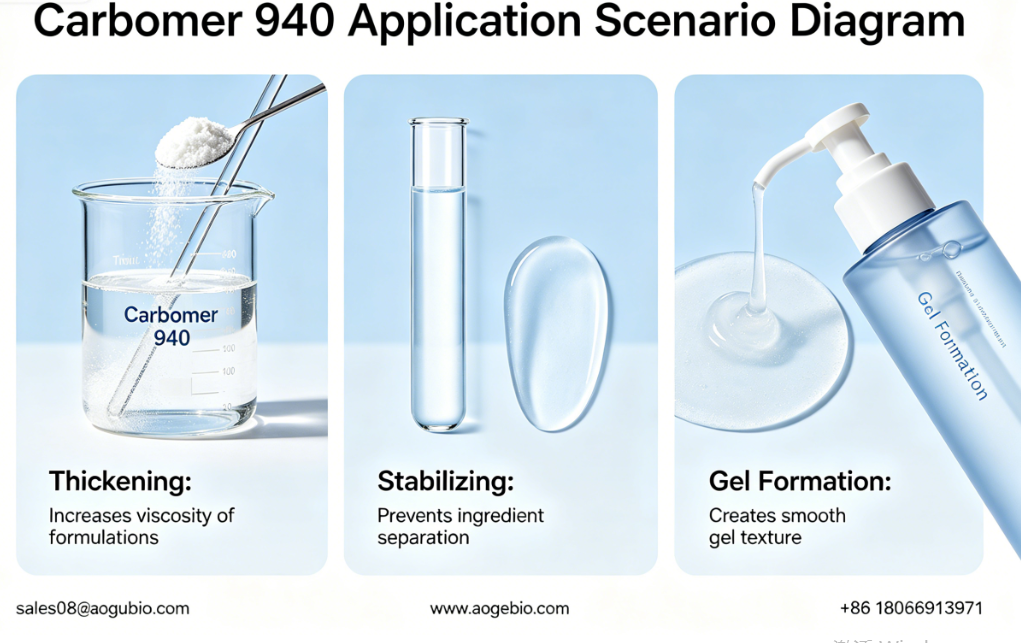
| Carbomer | Cross - linked acrylic polymer, swells and thickens when neutralized by alkali (transparent gel), highly efficient at low addition levels. Classified into types like 940 (high viscosity, film - forming) and 980 (low viscosity, refreshing). | Serums (980: refreshing gel, carry actives), creams (940: build thick texture, lock water and moisturize); eye creams (precisely control viscosity, fit eye skin) |
| Sodium Polyacrylate | Water - soluble polymer, highly water - absorbent (can absorb hundreds of times its weight in water), thickens and assists in suspension (stabilize powders, pigments). | Body lotions (suspend pearlescent powders and pigments, disperse evenly), cleansing mousses (thicken foaming systems, stabilize foam); baby powders (as thickeners in liquid formulations, replace traditional talc systems) |
| Polyquaterniums (e.g., Polyquaternium - 7) | Cationic polymers, with thickening, anti - static, and film - forming properties. | Shampoos (anti - static, reduce frizz, improve combability), hair sprays (form films for styling, thicken and stabilize systems); no - rinse hand sanitizers (synergistic thickening and antibacterial, optimize skin feel) |
| Acrylates Copolymer | Such as sodium acrylate/acryloyldimethyl taurate copolymer, excellent ion resistance, can achieve "light and transparent thickening" (low viscosity and high elasticity, non - sticky). | High - end serums (create "water - feeling gel", carry oil - soluble actives, micro - emulsion dispersion), sunscreens (stabilize oil - phase sunscreens, refreshing without stuffiness) |
Made from inorganic minerals, thicken through physical dispersion/adsorption, suitable for oil - based systems, formulations with high powder content, or products requiring "matte/dry" skin feel.
| Name | Features | Common Uses |
| Bentonite | Clay mineral, dispersible in both water and oil phases, thickens through platelet stacking, with thixotropy (thickens when stationary, thins when sheared). | Oil - based cleansing balms (thicken oil phase, give "soft and waxy" texture, easy to spread on skin), foundation creams (suspend powders, prevent sedimentation, improve coverage) |
| Fumed Silica | Nano - sized silica, forms a network to thicken through hydrogen bonding of surface hydroxyl groups, good transparency, can "dry thicken" (no pre - dissolution in water/oil required). | Transparent lip glosses (thicken oil phase without affecting transparency, create glass - lip texture), sunscreen oils (stabilize oil - phase sunscreens, disperse evenly without delamination); hair waxes (matte styling, thicken and give hair a fluffy feel) |
| Magnesium Aluminum Silicate | Layered silicate, forms a "card - house" structure to thicken when dispersed in water phase, excellent salt resistance, suitable for high - electrolyte formulations. | Sea salt body washes (stable thickening in high - salt systems, no delamination), exfoliating gels (suspend scrub particles, rub evenly) |
Use the melting point/crystallinity of oils and waxes to thicken, and at the same time give products "moisturizing feel" and "barrier property", mainly for oil - based formulations or creams needing thick feel.
| Name | Features | Common Uses |
| Beeswax | Natural wax (secretion of bees), contains esters and hydrocarbons, solid at room temperature, melts when heated to thicken oil phase, with emulsifying property. | Lip balms (build basic paste, moisturize and prevent chapping), cold creams (oil - in - water systems, classic moisturizing creams); hair oils (thicken and form films to protect hair, prevent frizz) |
| Carnauba Wax | Plant wax (from carnauba palm leaves), high melting point (80 - 86℃), high hardness, gives products "brittle - hard" texture. | High - end eyebrow pencils (thicken oils, make pencil core hardness moderate, easy to color without caking), lip glosses (assist in thickening oil phase, improve durability, create matte lip effect) |
| Stearic Acid/Stearyl Alcohol | Long - chain fatty acid/alcohol, thicken through "crystal network" in water - based systems (need to be neutralized with alkali to form soap for emulsification). | Creams (oil - in - water type, such as snow creams, form delicate pastes), lotions (assist in emulsification and thickening, improve stability); shaving creams (thicken foaming systems, smooth shaving) |
| Paraffin/Microcrystalline Wax | Petroleum - based wax, paraffin has low melting point (50 - 65℃), microcrystalline wax has dense structure (excellent weather resistance). | Lip balms (mixed with beeswax to adjust hardness, suitable for different seasons), shoe polishes (thicken oil phase, form shiny films); hair waxes (style and thicken, create matte/shine effects) |
Application Logic Summary:
- Aqueous solutions/serums: Priority selection of xanthan gum (ion - resistant), HEC (transparent film - forming), carbomer (refreshing thickening);
- Creams (oil - in - water): Commonly use CMC - Na (assist in emulsification), stearic acid/stearyl alcohol (build paste), carbomer (neutralization thickening);
- Oil - based products (cleansing oils, lip balms): Rely on beeswax, carnauba wax (thickening + film - forming), bentonite (thixotropic thickening);
- Special needs (such as transparency, anti - static, high electrolyte): Match corresponding functional thickeners (such as carrageenan, polyquaterniums, magnesium aluminum silicate).
In actual formulations, thickeners are often used in combination (such as natural gums + synthetic gums to control skin feel, inorganic + organic to synergistically stabilize). The selection needs to comprehensively consider cost, process, and regulations (such as requirements for the proportion of natural sources).